adventure

Tampilkan postingan dengan label author promotion. Tampilkan semua postingan

Kamis, 17 September 2015

'Book Week Coming Up' - Saviour Pirotta

It's that time of the year when teachers and and literacy co-oridinators up and down the country begin to organise their book weeks, a lot of which take place in October and early November.  For many writers, school visits provide an income stream which, along with PLR and ALCS, is becoming increasingly important in this age of heavy discounting and shrinking royalties.  I've been visiting schools for nearly thirty years now, so I thought I'd pass on some tips on how to get the most out of the experience.

We all know why the school has booked us.  They want to promote literacy and the love of books. They want the kids to get excited about reading and writing by meeting a real-life author.  But what do WE want from school visits? I find it pays to sit myself down once in a while and work out a school visit strategy for the next few months.  In fact I do this at the beginning of every term; it helps me decide which schools I accept to visit.

Do I just need the cash to keep me going till the next round of royalty payments, in which case I tend to say yes to the first schools that phone. That way I can get my p.a. diary filled and my work schedule planned as quickly as possible.  Is there a new book or series I want to promote or sell?  If the latter is the correct answer, I allocate some time to rehearsing my performance. I set about getting postcards printed, my website updated to reflect the promotion and harassing my publishers for extra free copies of the book in question. It's amazing how quickly a book starts to look tatty once it's been passed round a couple of staffrooms.


I find giving out postcards a brilliant way of promoting my website, and by extension my books.  I try to have an exciting image on the front and my website address on the back, in an easy-to-read font.  Children do not dip in out of the net like us grown up fogeys do; they inhabit it.  The first thing they do when they hear your name is 'google' you, so if you don't have a snazzy website for them to explore you're on a one-way hike to loserville as far as they're concerned.  Don't bother putting on any more info than your website address on the card.  Stick all that on the site itself, where children can check it out at their leisure.  If the site is attractive enough, visitors will keep coming back, giving you the perfect opportunity to engage with them and promote your books.  Which is a heck of a lot to get out of a little postcard!  I give mine out at the end of the day, usually sticking to one or two per class.  Resist the temptation to put details of your fb and twitter pages on the card unless you write books for KS3.  Children under 13 are not supposed to have any of these social media accounts.

Don't make the mistake of putting free stories on your site.  I did this for a while and it was alarming how many schools went from 'we bought some of your books' to 'we downloaded your stories from the net.'  Nowadays I tell the kids that if they log on to my site when they get home, they would find a free story.  But it only stays up for a day, and only appears after a visit, not before.


Some authors only visit schools if they're allowed to sell their books at the end of the day.  I don't do this, mainly because I don't drive and can only lug a few copies of my books around.  Recently, though, I signed up with Authors Aloud who organise the sale of my books with local bookshops. I do insist, however, that the children are familiar with my work before the visit.  More often than not they already have some of my books in the school library, although they are not always aware of it.  I just tell them to go have a good look round. Or I might suggest they borrow them from the local library. If you visit a lot of schools in the same area the local schools library service might even agree to buy a certain amount of your books which they send out in special 'author' boxes.

It sounds like a lot of work, and it is, but I consider author visits a vital part of our metiere and well worth the time invested in them.  And they're jolly good fun too!! It's like going back to school without the danger of being told off!    

Visit my site at www.spirotta.com
I do school visits through Authors Aloud. Visit their website here


Selasa, 12 Agustus 2014

What's the Point of Festivals?


I’ve just returned from Edinburgh on a train packed to the gills with rucksacks, sleeping bags, and the odd piece of bin-bag wrapped set. Yes, it’s festival time and the returning festival-goers include, as they have for the last twenty-two years, me.

I’ve also been a participant this year – talking at the Edinburgh Book Festival, just one of seven festivals that completely take over the Scottish capital every August. At the same time as I was talking to 80 children about The Dark Wild yesterday, Alex Salmond was discussing the referendum next door, and had you struck out in almost any direction from Charlotte Square in search of alternative fare, I guarantee you could have found some event to suit your palate.

Embedded image permalink
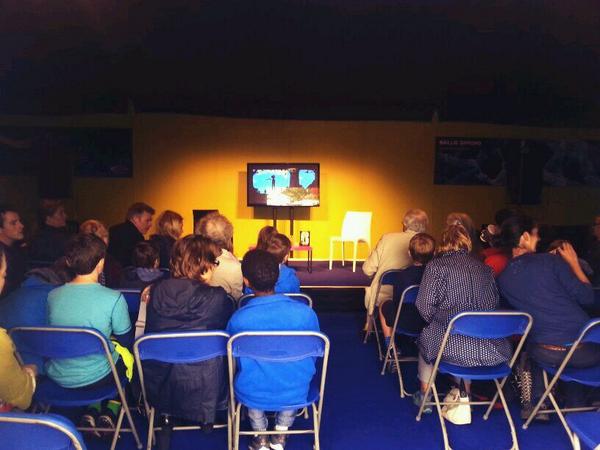
My audience at the Edinburgh Book Festival 2014

 I wasn’t with my partner on this occasion, who was giving a talk on a forgotten Elizabethan play…at another festival, Wilderness, in Oxfordshire. Wilderness is part of a new crop of ‘boutique’ festivals offering  a midsummer’s assortment of revels from hip bands to literary events to Madhatter’s Teaparties. The lakes and Arcadian lawns of Wilderness are a far cry from the cobbles and closes of Edinburgh, although this weekend they shared the same weather.

Earlier this summer we didgo to the same festival, to the brand new Curious Arts – a kind of Voewood-on-Sea, in the charming grounds of Pylewell Park, a Regency mansion with a view  from the terrace straight down to the Isle of Wight. You could dance to Ed Harcourt in the evening, listen to Lady Antonia Fraser on the Great Reform Act after breakfast, hunt a Jabberwocky in the Aboretum all afternoon, and finish the day with a gin cocktail leaning over a crumbling balustrade watching ships pass on the Solent.

Pylewell Park, the setting for the Curious Arts Festival


All very charming and civilised. But as I returned for the umpteenth time from the granddaddy of all festivals last night – I found myself meditating on the true attraction of such gatherings. What’s the point of a festival?

Let me first declare an interest in this British summer sport. I began my career programming a large theatre on the Edinburgh Fringe,the Pleasance (of which I am now a Trustee). Each year we have enough shows in enough different rooms to momentarily make us one of the largest arts venues in Europe.

I’ve sat in the sun at Hay and waded through the mud at Latitude. I’ve spoken at a tiny theatre festival that just takes over three floors of one building in Suffolk and a new book festival in Devon which was just a room in a library.  Later this year I’ll be leading a wildlife walk at Bath Festival and then dashing off to sit on a panel at Cheltenham. You can festival it up from Port Elliot  to Adelaide to Dubai, if you want to.

It would seem that we are at peak Festival, with over 700 events taking place this year classified as one,  about 300 of them literary.

 As a writer, you will be told many things about festivals, as I know theatre companies, musicians and comedians are told about theirs. You will be told they are essential for profile, that ‘festivals are the new bookshops’ and a great way for connecting with readers.

I don’t wholly dispute those things. Being in a Festival programme, especially an established one, does lift  perception of you and your titles. Sales wise I’m less sure – I had a sold out talk at Edinburgh yesterday, in a 75 seat room, and probably sold 20 odd books, which is great - but it’s not the sole reason I went.

You certainly don’t go for the money. Some Festivals, like Bath and Edinburgh offer a token fee, and some like Hay, offer a case of wine and a flower. And as someone involved with the running of a festival venue, I can report that the ever increasing rental, accommodation, promotional, regulatory and staff costs associated with mounting one of these temporary gatherings mean profits are only ever normally found behind the bar rather than the box office.

It’s not cheap for audience members either.  Individual events may carry an average ticket price of £8-10 but the travel, accommodation, taxi and food/drink bill means the minimum festival tab comes close to the £100 prices offered by the all inclusive weekend events like Curious Arts, and can be often more - if you visited Edinburgh all week, for example.

Why do we all go and what do we take away?

A dull critic of this pastime might argue that at best audience members take away an empty wallet and often a hangover, and we take away some book sales and inclusion in a programme mailing list.

Of course, all of us are in search of something much more profound.

Festivals may be promoted effectively but I would not place them under the heading of ‘Effective Promotion’ for any artist. There are numerous more sober and less fun ways to do that – just speak to your publisher’s sales and marketing department. But festivals are also fun for them to attend too.

Festivals, especially the summer ones, satisfy a much deeper urge in us to ‘gather.’ Writing, as we all know, can be a damnably lonely business, just you, your ideas and a cold screen all day long. School visits are often hectic and at best your longest conversation with an adult might be five minutes on logistics over a coffee in the staff room.

I think all of us, from writers to actors to comedians to singers to audience members, go to festivals primarily to talk, and to connect. We need our events, sure, we need a reason to gather, our cover story; but the real business of a Festival takes place in the green room, the author’s yurt, the performer’s bar and the pop-up café franchise. 

The classic image of a festival is a big tent, and that is the heart of their appeal. Where else can one talk to Archbishop Emeritus Rowan Williams, the Gruffalo and First Minister Salmond all in one room? Even if I chose not to. They are harvest festivals without the back breaking labour (unless perhaps you’re in an acrobatic troupe), weddings for all, and the very best are always tinged with midsummer madness.

Embedded image permalink
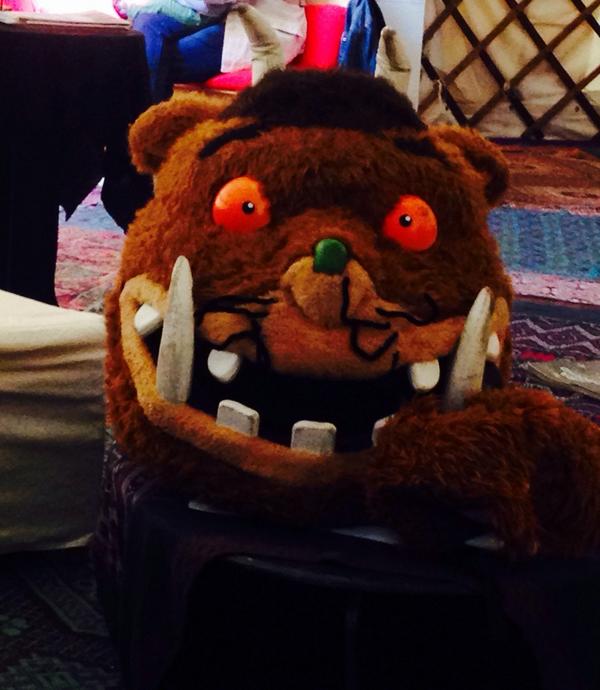
The Gruffalo loses his head at all the excitement in the Edinburgh Author's Yurt

We gather, we discover, share ideas, news, worries and gossip like crazy.  Twitter handles become three dimensional, books expand to reveal the lives behind them, and readers are no longer scary anonymous Amazon commenters.

We might sell the odd book or register with a bookseller who didn’t know us before. All of which is great and worthwhile. But next time your publisher invites you to a festival, don’t worry too much about the fee or whether the sales will be worth it, just gather in the tent  (ideally under a super moon) and enjoy the craic.

Piers Torday
@PiersTorday
www.pierstorday.co.uk

If anyone has any memorable Festival experiences, good or bad, do share them below!


Rabu, 29 Januari 2014

The Seven Stages Of A Book - Lari Don

A book goes through many different stages as it travels from the writer’s mind to the reader’s mind, and the writer’s relationship with the book changes at each stage.

This week, I’ve experienced one of the major shifts in my relationship with a book: when it goes from being something I have the power to change, and becomes something I can no longer change, but must now start to promote. And I think I find this shift the most terrifying of all.

But looking up at my shelves, some with only a few sheets of scribbled paper, and some creaking with heaps of notebooks and piles of manuscripts, I realise that I have a book at almost every stage here in my study.

When I’m writing, I go through seven stages of a book, which may be conveniently Shakespearean, but does seem to accurately represent my writing process. I wonder if other writers recognise these stages?

# 1 The thrilling moment when the idea for a book emerges, which may be the only moment the book is ever entirely perfect!

# 2 Thinking and scribbling and considering: ‘what is this story about?’, ‘what am I trying to find out?’, ‘who are my characters?’, ‘what are the big questions?’, ‘what happens next?’ ‘how will I ever defeat the baddie?’ This bit is incredibly exciting, filled with possibilities.
the scribbling stage

# 3 Actually sitting down and writing it. Finding the story and putting it into words. For me this usually involves lots of self-imposed deadlines, late nights and ignoring my family. I find this bit exciting too. (I realise, writing the stages down like this, that I find every stage of writing a book exciting. I suppose that’s why I’m a writer…)

# 4 Turning the story into a manuscript. My first and most personal edit - lots of reading out loud, and cutting the word count by massive slashing and burning. This stage is perhaps less heart-thumpingly exciting but it is very satisfying.

 # 5 The real editing, with an actual editor. This stage can be emotionally draining, but by this time I can also see the original idea turning into a book that other people can read. Which is, of course, quite exciting!
the proofreading stage
 
# 6 Proofreading of the layouts. I did this last week, for my next novel Mind Blind. This stage is both exciting and chillingly terrifying. Any silly little mistakes I miss here will be printed in real books to be read by real readers. Which is a great incentive to keep your eyes wide open and focussed as you proofread!

# 7 Finally, the shift I’ve experienced this week: the shift from the writer creating a story to the writer promoting a book. I’ve stopped meeting new characters, and started having meetings with marketing people. I’ve stopped writing the story and started looking for extracts of the story I can read at book festivals, I’ve stopped thinking about chapter length and started thinking about ‘content’ for websites.

Can you tell I find this final stage a little less exciting? But really, this should be the most exciting shift of all. This is the bit where I look ahead to the story being read by readers, and that is, after all, what really excited me right at the start when I had the original idea, which got me scribbling, which got me writing, then editing…

Anyway, even if I will spend the next few months promoting this teen thriller, I’ve also just had another idea. So I’m starting a new relationship, with a new story and some new questions and new characters, and perhaps that relationship will go all the way too…


Lari Don is the award-winning author of 20 books for all ages, including a teen thriller, fantasy novels for 8 – 12s, picture books, retellings of traditional tales and novellas for reluctant readers.