adventure

Tampilkan postingan dengan label David Thorpe. Tampilkan semua postingan

Selasa, 29 Desember 2015

Six things that must happen to reverse this headlong rush to an illiterate British generation

Halfway through 2011 came a horrifying National Literacy Trust survey of more than 18,000 children.

It listed the following staggering statistics:
  • one in four children is unable to read or write properly when they leave London's primary schools
  • three in ten live in households that do not contain a single book
  • one in six people in the UK have the literacy level expected of an eleven year old
  • in 2005, 1 in 10 of the children and young people surveyed said they did not have a book of their own at home; but by 2011 this figure had increased to an incredible 1 child in 3.
Why is this not seen as a national scandal?

I believe it's because we have two cultures in this country. Those of us who are educated and read all know other people like ourselves who encourage their own children to read.

For these statistics to be true, we must be outnumbered by those for whom reading books is virtually an unknown pasttime.

All my life, newspapers have been wringing their hands about the levels of childhood and adult literacy.

Successive education ministers of every political hue have experimented with different teaching methods.

And all this time the problem has been getting worse and worse.

I believe that it's a root problem of our British culture; a culture that is leading to the closing of so many libraries.

Library closures

I learned my love of books from my local library.

But the latest figures on closures are that 415 libraries (323 buildings and 92 mobiles) are currently under threat or closed/have left council control since the beginning of this financial year out of around 4612 in the whole country.

Librarian professional body CILIP forecasts are even worse: it says that 600 libraries are under threat (inc. 20% of English libraries).

This does not include school libraries. Here, as this article from the Guardian reveals:
  • school libraries are facing drastic funding reductions
  • many school librarians are being downgraded or even made redundant
  • School Library Services are closing
  • some children’s book awards have folded
  • book gifting schemes have had their funding reduced
  • some schools have postponed author visits.
Every month brings bad news: in December we learnt that Hertfordshire Schools Library Services, one of England’s largest and most respected Schools Library Services, is set to close in the New Year.

The latest library visitor figures, covering the year to March 2011, showed overall library visitor numbers down 2.3% to 314.5 million and book issues down 2.9% to 300.2 million.

Although this is a reduction, it is less than what you might expect given these closures.

In November, Alan Gibbons called for a moratorium on the closure of libraries.

Tackling illiteracy and library closures was also the subject of Patrick Ness's Carnegie Medal acceptance speech, which he won with Monsters of Men, the third of his Chaos Walking series.

Too often, writers are told by publishers (I was told myself this year) that teenage boys don't read books and so we can't publish your book.

What can we do?

As writers, we must join with Ness and Gibbons. We can no longer be complacent. Our livelihood is at stake.

Yes, we have to keep writing compelling books. But we also have to act.

Here are six things that need to happen:

  1. We must be prepared to occupy libraries faced with closure, just like the occupy movement.
  2. The government must stop closing libraries and encourage more children to read in every way possible; even if it comes to giving away books. This happens in developing countries where the level of literacy is higher than ours, for God's sake!
  3. Publishers must reconsider the pricing of books. Books are expensive compared to other media which children enjoy, much of which is free, like television, the Internet, radio, music and video games. There needs to be a range of cheap books aimed at less literate children to get them reading so they can later migrate to more difficult books for their age group.
  4. The pricing of e-books needs to be much, much cheaper (for the iPad etc.), with all kinds of promotional tools like the vouchers used by iTunes, which would be the modern equivalent of book vouchers.
  5. Reading books must be made more cool. Celebrities rated by children need to come out and encourage children to read.
  6. You should get involved in CILIP's advocacy work on school libraries and schools' library services, if you aren't already.
It's going to take a lot of effort to turn this devastating trend around. But for the sake of the next generation, we have to do it.

Kamis, 03 Desember 2015

Doris Lessing, graphic novel writer - by David Thorpe

The great Doris Lessing died last month. Amongst the many eulogies and obituaries I've seen no reference to the book I commissioned from her, written for older children: Playing the Game. So, in memory of her, I'd like to share the story of how it came to be, and how I met her.

She was a beautiful, exceptional person. The few hours I spent with her are extremely special in my memory. She invited me into her home, we shared meals, we looked at artwork, and all the time her viewpoints were surprising and incisive. Above all, she displayed a constantly fearless, enquiring and self-critical mind.

Playing the Game is a graphic novel. For her the ideal audience was young adolescents just beginning to step out into the world. It's an allegory, a call to adventure. 'The Game' in question is a metaphor for life.

Did she think she was "writing down" by writing a comic book or for children? Quite the opposite: "Playing the Game is one of my best ideas" she said.

The book formed part of a series of literary graphic novels I put together, the rest of which were never published. This was the first to be commissioned. The fact that Doris was so enthusiastic about writing a graphic novel meant that many other outstanding literary authors agreed to be part of the series.

She urged many of her friends, including Salman Rushdie, Martin Amis, Jenny Diski (whom she described as her ‘protegé’) and Angela Carter, to get on board, so open was she to the concept that I had pitched to her, initially via my friend Nick Webb.

This all took place between 1991 and 1995. I had been taken on by the publisher Macdonald-Futura to put together this list, which I now consider forms a lineup of the most beautiful works of literature never published.

The concept I came up with was to match formidable literary talents with the cream of international comics artists for a line of original graphic novels. Besides Doris' friends other authors who did respond positively to my invitation included Peter Greenaway, Kazuo Ishiguro, Lisa Alther and Brian Aldiss. The books would be awesome.

I have a signed, handwritten postcard from JG Ballard. It reads: “Thank you for the invitation, but graphic novels are not for me.”

I have a similar letter from Martin Amis. But he adds: “Should [writing a graphic novel] ever seem like a good idea, I’ll keep you in mind”.

Salman Rushdie’s agent also declined the invitation, as did Douglas Adam’s assistant, giving the excuse “he is at present heavily involved in writing his novel Mostly Harmless.”

But Doris Lessing was more than enthusiastic.

The first time I went round to her house in West Hampstead was with a pile of different graphic novels so that she could choose an artist. We spent a happy hour going through them. I was gobsmacked by her first choice: the Heavy Metal artist of 2000 A.D.'s ABC Warriors and Slaine, Simon Bisley. I knew Simon - he was an iron-pumping bike-riding working-class lad who had a big fan base in Hell's Angels.

His artwork was bursting with macho energy, imaginative and attention grabbing. It just jumped out of the frame. That she picked him was a measure of her understanding of the power and appeal of the genre. He was a hot and upcoming artist.

When I put the proposal to him he rejected it outright. He'd never heard of Doris Lessing and the fact that she was a Nobel prizewinner cut no ice whatsoever.

Her next choices were artists with a similar virtuoso dramatic style: Duncan Fegredo and Daniel Vallely. They too had never heard of her, didn't like the script and rejected the offer.

I was beginning to see the problem: these working class artists were mostly anarchic types whereas Doris Lessing's appeal was to quite a different audience. It says a lot about her wide-ranging tastes that she was enthusiastic about them - but it was unfortunate that the feeling was not reciprocated.

From these artists' point of view there was also a problem with the script, for she initially had not written a conventional comics script, which is broken down into pages and panels, but something looser, leaving room, she said, to allow the artist freedom to interpret. This freedom, they felt, demonstrated a lack of understanding of the medium. I don't believe it did for a minute. She understood the medium very well. But we refined the script as follows:

Page 4 of her typed script:


What she had written was essentially a libretto for an aria for an opera and she talked passionately about wanting her friend Philip Glass to write the music for it.

She invited me round for dinner. As her son, Peter, for whom she cared most of her life, hovered in the background, a constant presence, we talked about her disillusionment with Communism and what it was really like in Brixton during the riots. Under questioning, I conveyed why my anarchist friends, including those who were 'slumming it' from higher up the social strata (just as in her novel The Good Terrorist), thought that the portrayal of the terrorist was unrealistic, and she listened without a trace of defensiveness. Always her voracious non-judgemental mind sought out new information.

Both the series and this book had a chequered history in eventually being published, which is outlined below. In the end HarperCollins, who had just bought up the rights to all of her work, said they were keen on publishing Playing the Game.

I ultimately succeeded in finding an artist, Charlie Adlard, who had cut his teeth on a few minor Marvel Comics titles, to agree to to draw it. His style was much milder than the artists Lessing originally chose, which was a disappointment to us both. By this time I had moved from London with my family to mid-Wales. Charlie lived in Shrewsbury. We would meet in Shrewsbury pubs and he would come down the Cambrian Line to Wales, to discuss the progression of the artwork.

HarperCollins appointed a desk editor for the title. Sadly she had absolutely no experience of comics or graphic novels. The book came out in 1995. I must confess I was never happy with its final form, which I don't think did the story justice. It did not garner rave reviews; but what do critics know?

A page of inked artwork:


The same page as it appeared in the book having been coloured:


Two pages that did not appear in the finished book in the same form:


More about the series

In 1991 I was a freelance commissioning editor and writer. I had already been working for a decade as a comics writer and desk editor of UK editions of such titles as Watchmen by Alan Moore, Frank Miller’s Dark Knight Returns, Dave McKean and Neil Gaiman’s Violent Cases, plus European bandes desinées like The Magician's Wife by French comics creators François Boucq and Jerome Charyn.

Nick Webb was then MD of Macdonald-Futura. I had initially won the support of John Jarrold, now a science fiction literary agent, but then editor of the Orbit SF imprint, for my project. He got Nick excited and off we went.

The full list included, at one point, film director Peter Greenaway matched with the seminal (and very edgy) Judge Dredd artist Brian Bolland (they had long admired each others’ work, unbeknownst to one another), a work by Brian Aldiss called Her Toes Were Beautiful In the Water, to be illustrated by Italian artist Lorenzo Mattotti, and Uh-Oh City by Jonathan Carroll and Dave McKean, who had also, until I introduced them, only admired each other from afar. Dave went on to design book covers for Carroll.

You might wonder why this series did not appear other than for Doris' title.

Here is where this tale enters the realm of the gothic farce. The publishing house Macdonald, with its office near Holborn, was, like Fleetway, publishers of 2000AD, part of the vast, serpentine publishing empire owned by Robert Maxwell, then the neo-socialist arch-rival of über-capitalist Rupert Murdoch, whose own vast serpentine empire included HarperCollins. Maxwell was publisher of the Daily Mirror, which was head-to-head with Murdoch's The Sun.

On 5 November 1991, Maxwell famously slipped over the side of his luxury yacht, the Lady Ghislaine, off the Canary Islands, and his body was later found bobbing in the Atlantic Ocean. His empire imploded in a financial firestorm. Time Warner eventually bought Macdonald, but they didn’t want my series.

This situation wasn’t helped by a report from Macdonald's sales department, which was overwhelmingly negative and is worth quoting from, because the situation is so different today. They said “Reaction has ranged from disinterest to hostility...” the sales force has “a sour taste" following the “failure of Fleetway’s graphic novels”.

Fleetway's series consisted of collections of strips like Judge Dredd from 2000AD, which I had edited for Titan Books, and which were apparently overpriced for their teenage market - so were anecdotally the most shoplifted volumes on the market. “All major wholesalers have been apprised of the nature of the forthcoming list,” said the report, “and have not been interested”, even though a BBC documentary was promised covering the making of the series.

Undeterred, for several months I hawked the list around publishers both British and foreign. These expensive books largely required co-editions setting up with publishers abroad in order to make it financially possible to pay the authors and artists a reasonable fee, and the production and printing costs, and I worked hard at trade shows trying to secure these.

Editors were enthusiastic but could not make it work financially. Eventually HarperCollins, owned by Maxwell’s old rival Rupert Murdoch, accepted Playing the Game.

One of the most interesting potential titles for me was Angela Carter’s Gun for the Devil, a retelling on the Mexican-US border of the plot of Carl Maria von Weber's opera Der Freischütz (The Freeshooter). Angela and I lived not far from each other; she in Clapham and I in Dulwich. We met in her favourite tea house on Clapham Common, at the time when she already knew she didn’t have much longer to live. It was very poignant.

She didn't look ill, but radiant. She told me she wanted as much of her work published as possible, in order to provide royalties for her surviving husband and son. A version of Gun for the Devil was eventually published after her death in an anthology, American Ghosts and Old World Wonders. The version I have is a treatment.

Kazuo Ishiguro’s story was The Gourmet (a fabulous ghost story that was not original alas, but an adaptation of a tv drama), which Dave McKean also agreed to illustrate.

Iain Banks was keen to be part of the series but his agent demanded too high a fee; he and Belgian artist François Schuitten, who drew the visionary Citées Obscures series of graphic novels which I love, would have been a perfect match, and François was certainly up for it.

American writer Lisa Alther was also very enthusiastic when we met in a café in central London, and sent a magical story about how all large inland lakes with lake monsters, like Loch Ness, are connected by underground water-filled tunnels, based on a monster she had seen in one of the Great Lakes which bordered her home.

Other onboard contributors to the series included science fiction writers Chris Fowler (paired with John Bolton), Patrick Tilley, Alan Dean Foster (who with Colin MacNeil would produce a book in his Spellsinger series), Grant Morrison (a piece called W to be illustrated by Bill Koeb), and a three-book series by Shaun Hutson.

My trawl of the literary scene also landed me in fascinating encounters with William Burroughs, Jeanette Winterton, Frank Herbert, Ben Elton, Jenny Diski, Faye Weldon, Sue Townsend, Umberto Eco and Terry Pratchett.

I would still love to see this series see the light of day. Nowadays, 20 years on, the market for graphic novels is very different. I believe it would welcome a list like this. I still have files of scripts or synopses in my drawers.

© David Thorpe

Sabtu, 21 November 2015

Discipline: the need to write and the craft of writing

These days, writers are supposed to be a brazen brand; masters of mobile and internet wizardry; and magicians of marketing. And they have to create "products" too.

It's easy for the time required for the craft of writing to be squeezed, and this has led me to consider the nature of 'discipline'. See where I'm coming from?

When I grew up, "discipline" was kind of a dirty word. It's also a frequent topic of questions in interviews, as in that awful one: "It must take a lot of self-discipline to write a novel/be a writer".

Well, no, we tend to answer patiently... self-discipline is not an issue. If you have the Calling to be a writer, actually you can't help it. In fact, you go crazy if you DON'T get the time to write.

For example, when unable to write for prolonged periods, I am prone to the feeling that I will start scraping the wallpaper off with my fingernails or yelling something deeply regrettable at my loved one if I can't get back to it very soon.

Yes, others might call it a form of mental illness, but, as anyone will know who has read biographies of many top entrepreneurs (like Steve Jobs), scientists or artists, this kind of obsessive-compulsive behaviour is a pre-requisite for success in many fields.

However nice a person you are, you have to demand the time to write, and this is not to be considered weird. Other people have no choice but to clock in nine to five, 46 weeks of the year. You have to claim that time for yourself.

What's almost pathological is the frustration I feel at having to spend hours doing all the self-marketing, twittering, email-answering, bill-paying, phone-call returning, website-updating, meeting-attending, computer-fixing, filing, tidying and a hundred-and-one other things – and it seems to be getting worse - before I can get a tiny window of time to do the one thing which I, however strangely, feel I was put on this planet to do.

Now, I'm one of the lucky people who make most of their living from writing. Lucky, but underpaid. I have to do several different kinds of writing to survive rather than just write fiction (my favourite form), and I feel that I've worked hard to be in this place.

For the past year, my work pattern has changed, involving a new discipline, and this has had an interesting effect on my writing.

Every weekday morning, I have to write an article, as soon as possible and usually within two hours, of about 700-1000 words, and post it on a web site.

This is an enforced discipline, but one that pays off well in terms of developing the discipline of the craft.

Typically, I have no idea before I start what the subject will be, and have to research it as I write it.

This type of journalism, for a specialist, largely business, audience, demands many qualities apart from accuracy and readability.

In particular, there is an instinct for what people want to read that no one else is providing, which can only come from knowing the field intimately.

There is also the kind of fluency that comes from being able to trust oneself that the process of writing at speed will result in something that isn't completely unintelligible and is of great interest to my readers.

This is a very different process from writing a novel, partly because it operates on a totally different timescale. It is topical, and so consumed, like a meal, within hours of preparation, after which it is likely to be forgotten; although one hopes that it will have greater influence, just as a top chef's creation may be talked about for long after it has disappeared.

The self-editing process is therefore different. When writing a novel, one can leave a draft for a few weeks so that, when re-reading it, one may see it afresh and notice errors and omissions that were obscured by the afterglow of creation.

Since adopting this new work pattern, and because I cannot expect my editor to spot my errors, I have developed new techniques to force myself to both edit as I write and to see my work freshly as if I had left it for weeks, even though it was only minutes. These techniques have fed into the novel-writing process.

I continually edit as I write, checking that I've said what I meant to say. I write in a text editor, not a word processor, so I can concentrate on the words alone, not be distracted by how they look.

I re-read and correct it, then copy and paste it into OpenOffice. I do the same there. Then I copy and paste that into TextEdit (I use a Mac) and repeat the process. Both of these have spell-checks that notice different words (OpenOffice doesn't check American spellings).

Each time I paste it into different software, it looks different, and my eye is forced to notice different things.

So I'll have read and re-read, continually correcting, this blog copy several times this way before posting it. Even so, I won't be surprised if someone spots a mistake!

There we have it: two types of discipline. One, that is about finding the time to write; the other, that is about the development of the craft.

Selasa, 03 November 2015

Educating Gove by David Thorpe

Another year, another shakeup of the examination system in England.

Michael Gove (I don't know about you, but he always reminds me of Archie Andrews from Educating Archie. That's Archie on the right below) has announced that young teenagers will have to study more spelling, grammar, Shakespeare and boring stuff like that.


I studied stuff like that, and look where it got me.

At least I live in Wales, which is not affected by such madness.

Make them learn Latin, that's what I say. I learnt Latin and I'm sure that helped me become a better writer. Nothing to do with imagination.

Shakespeare is so relevant to today, isn't it?

Joking aside, I don't care exactly what children learn. It's the way they are taught and by whom that matters. Qualified, enthusiastic teachers.

Learning must be fun if it isn't to alienate children from the system, from their inate eternal curiosity about the world, from an enthusiasm and thirst for new experiences.

And most importantly school must encourage critical thinking.

I read today that in a certain country textbooks and curriculum in schools "not only discourage critical thinking, but foster intolerance and hatred".

So said speakers at a panel discussion at a Children’s Literature Festival. In which country? Read on.

“When emotional and sentimental content, as opposed to objective fact, is added to the curriculum it adds a sense of intolerance, bias and even hatred. That is how our curriculum is designed”. That's what one of the delegates said in a discussion on ‘Curriculum and textbooks: do they promote critical thinking?’

Okay, the country's Pakistan and the speaker was Pakistan Minorities Teachers’ Association Chairman Professor Anjum James Paul.

Now I know Michael Gove gets all starry eyed, emotional and sentimental when he talks about making children in all those parts of England which are no longer full of white Anglo-Saxons learn to speak the Queen's English, recite all the kings and queens of England and their dates and learn Shakespeare and Tennyson by rote.

But does he realise that he is emulating Pakistan's education policy?

Anyway, you don't need to hear this from me. Just listen to some of the delegates at this children's literature festival:

Raheela Akram, principal at the Sanjan Nagar School, said that both teachers and-students were confused about textbooks and curriculum. “Our books are knowledge-based but they fail to address critical thinking”.

Ameena Saiyid, managing director at the Oxford University Press, said that examinations were based on textbooks and not the curriculum. “Students are merely required to reproduce content verbatim. How is that going to promote critical thinking?”

Tanveer Jahan, executive director at the Democratic Commission for Human Development, said unless the textbooks were based on truth, they would fail to encourage critical thinking. “Is the purpose of our curriculum to produce good Muslims or good citizens?”

Sound familiar? Okay, Mr Gove, “Is the purpose of our curriculum to produce good patriots or good citizens?”

Sabtu, 17 Oktober 2015

This blog post has no title!

I have just changed the title of the novel I'm currently working on.

Again.

I just can't decide on the right title. I almost feel like letting the publisher decide.

Just think how important the title of a book is. A good one will not only be memorable but make potential new readers actively seek out the book.

It will resonate in your head like a tuning fork. Stick in the mind like stubborn egg stains. Have an emotional punch like Muhammed Ali.

A good title even becomes an icon or a touchstone in its own right.

Catch-22. 1984. Brave New World.

It can also signify the genre.

The Weirdstone of Brisingamen
could not be anything but fantasy.

The Unquiet has to be a thriller.

It can be eponymous, like Anna Karenina or Emma Bovary; or signify the theme, like Crime and Punishment or Pride and Prejudice.

Or it can be quirky, like The Curious Incident of the Dog in the Night-time, or The Knife of Never Letting Go.

And just silly and quirky, like Puckoon, or The Long Dark Tea-Time of the Soul.

At the same time as thinking about this I'm reading an autobiographical monograph by Haruki Murashami called What I Talk About When I Talk About Running.

People, he says, often ask him if, while running, he is thinking about the novel he is currently writing.

"No," is his answer. Actually, he is thinking about nothing. Or, as he puts it, The Void.

Now, here is an interesting place. I love The Void so much I have a room permanently reserved there.

The problem is, I often lose my way when trying to reach it.

The Void is variously also known as The Still Point of the Turning World (T.S. Eliot), The Supreme Point Where All Contradictions are Resolved (André Breton and the Surrealist Manifesto), and The Uncarved Block (Chinese Taoist Art training).

In a world drowning in a surfeit of words, to which we are all, writers par excellence, fatally addicted, The Void is reached by taking a Journey to the East - which is East of Eden - by jumping off Brighton Rock, following the Songlines along the Road to Wigan Pier, through the Heart of Darkness, crossing the Tropics of Cancer and Capricorn, at the end (where else?) of The Road Less Travelled.

Not enough people go there.

It's quiet: in The Void you can't even hear yourself think.

Here, you can try without trying, be without wanting, start without stopping.

All opposites are reconciled like identical poles of a magnet brought together as if they were north and south.

And here, as Pierre Reverdy said, is the place where the most successful poetic images are generated.

"The image is a pure creation of the spirit. It cannot emerge from a comparison, but from the coming together of two distant realities. The more the relations between those two realities are distant and right, the stronger the image will be - the more it will have emotive force and poetic reality."

Is not this also what we require from a successful book title?

So what, you're hopefully wondering, is the title I have settled on (at least until a better one comes along)?

In truth, it's not one I thought of myself. I have my fiancée, Helen, to thank.

She, being a musician and composer, knows the Void well, since music is another conveyance that transports to it the sympathetic mind.

The rejected titles were: The Drowning. The Essence. The Ending.

The new one: Stormteller.

Would you pick up a book with such a title?

Sabtu, 03 Oktober 2015

"You is well old now innit?" - David Thorpe

No, this wasn't something one of my kids just said to me - but the message on a 20th birthday card to my stepson last week...

It made me think of the challenge a groan-up writer has in making authentic the speech patterns of their teenage characters.

A Mancunian editor this month asked me to look again at the dialogue of one of my teen characters. I've re-read the dialogue and ok, there's always room for improvement, but my question is: what constitutes perceived authenticity?

Firstly, I know plenty of educated teenagers, like my characters, who speak fairly adult-like. They may also come out with "It was like awesome and totally mad" type idioms from time to time, but only when discussing certain things, usually geeky stuff.

They can easily switch to more adult diction when discussing serious topics. Not every kid talks like a south London wannabe rap artist.

What's more if you do any research online on how teenagers are supposed to talk you come across hilarious threads like this on mumsnet, where parents are striving to make sense of their youngsters' slang.

What this thread drives home is that this slang varies dramatically from one part of the country to another, almost reassuringly continuing to maintain regional differences.

What's more, much innovation comes from youngsters themselves experimenting creatively, coming up with either new words or different meanings for existing words. Their ears are hyper-tuned to naunces and new phrases uttered by their peers and by artists they listen to.

It's both a competitive process - being the first to latch onto a new trend - and a collaborative, peer group-gelling one.

I remember it well from my own teenage years. A few of these words go mainstream, many die out in a kind of Darwinian selection process.

The regional variations may explain part of the problem my Mancunian editor is having. So here in South Wales kids still use words like "crackin'" and "oober", but I have no idea what they say in Manchester.

Then again, there's the class angle, and it's more likely that working class (if I can use this term - I tend to avoid the c**v word) are going to use this type of slang than middle or upper class kids, who will speak more proper, like.

Moreover, my book is set 18 years into the future, and I can't possibly know how teenagers are going to be talking then, nor do I want to distract the reader by inventing new slang, which has been a recent trend in literature, triggered by Russell Hoban's Riddley Walker and taken to extremes by, say, David Mitchell in Cloud Atlas, that I consider has been a bit overdone by now.

Actually I think creating authentic teenspeak's got less to do with the slang words used and more to do with what thinking processes and abilities are revealed in speech.

Teenage boys in particular are not exactly renowned for being articulate and expressing or understanding emotions, are they? Then again, some are better than others.

They will reveal themselves by what they don't say as much as what they do say.

So I'm interested in other YA writers' approach to this problem. How do you go about making your characters seem convincing in speech?

Do you base them on existing people you know? Do you make up words? How do you avoid the problem of dating in language, or don't you care? Do you have young readers you test out dialogue on?

Kamis, 03 September 2015

Creating a page-turning novel - by David Thorpe

I've almost finished editing the first draft of my most recent novel, which is the longest I have ever written at almost 100,000 words.

I began the novel in February and, while I had a fairly detailed synopsis, many things had to be filled in along the way.

For me, the first draft is a way of getting the substantial majority of the narrative and plot nailed down. Major issues of character consistency, providing credibility and substantiating plot developments have been inserted.

As a result the current draft is substantially different in emphasis from the original synopsis.

There are plenty of really good blog posts around on the process of editing, so I won't repeat any of that advice.

Instead, in a moment, I will get to the point hinted at in the title of this post.

The overall effect given by the novel is uncertain until you as the writer get down to reading your first draft from beginning to end.

This, fortunately for me, was in this case a satisfying pleasure.

Although in places I was horrified to discover the naivete of some of the writing, before hastily correcting it, it's exciting to see for the first time the sweep of the narrative from a bird's eye view, instead of the snail's eye view that you have when crawling along word by word.

One could spend money paying a therapist to find out why one unconsciously repeats certain words and phrases over and over again during the narrative. In 99% of cases these words are entirely superfluous.

A particular point I'm paying attention to in the editing is chapter lengths and transitions.

During the writing process, my chapter lengths tended to be long and inconsistent. I am now slicing them up quite drastically.

The average length is between two and four pages.

The point at which the transition occurs is typically either in a change of scene or at a climatic moment.

My overriding criteria is to create a page turner. To this end I enjoy playing with readers' expectations.

Having decided where the break is to occur, I pay particular attention to the last sentence of the preceding chapter and the first sentence of the next one.

Each of these typically, but not always,  are set on their own line.

The last sentence of a chapter will perform the role of being a cliffhanger in a major or minor way.

The first sentence of the next chapter will to some degree be a scene setter. Here is a simple example:

Then she was shepherded through a door and disappeared from view. 

123. Vanishing 
An assistant escorted us to a small room where a monitor let us view the interior of the spherical transformer chamber.

That's fairly straightforward. This one is a little more playful:

Minutes seemed to pass. Nothing happened. Nobody came.

124. Cold shock 
By now I was desperate for the restroom. I opened the door and stepped into the corridor.

The last sentence of the preceding chapter defies expectation in the sense that the reader, along with the characters, is expecting some incredibly dramatic event to occur at this point in the narrative. The fact that nothing does will hopefully itself arouse curiosity.

At the beginning of the next chapter, the fact that the protagonist needs the restroom (the only time he does in the entire narrative) introduces a bathetic effect, continuing the inverted suspense, because we are at a high point in the narrative two-thirds in, to which the whole story has been building so far.

The quest to find the restroom will lead to an important discovery.

Note that in each case the section title gives a clue as to what will happen in the next section and, hopefully, an incentive to continue reading, without giving anything substantial away.

At every point I am asking myself four questions:

  1. What does the reader know now? 
  2. What do they want to know? 
  3. What should I tell them?
  4. How shall I continue to maximise the suspense?

You have to drip feed the readers something to satisfy their curiosity, otherwise they will just give up in frustration.

But if you give them too much there is no incentive to keep reading.

Generally, there are several levels of suspense going on at any one moment. Some of them constitute small arcs in the narrative, others continue for longer.

And there is the overarching suspense arc of: will the protagonists succeed in the challenge given to them at the beginning of the story?

Part of the pleasure of writing and editing is setting 'plants' - and 'red herrings' - throughout the narrative to be paid off later, often in surprising ways.

Since you yourself know the significance of these snippets of information, one of the most difficult parts of editing is being able to judge whether they are either sufficiently obvious, or not too obvious, to the reader.

Ultimately it's best to have someone else read the manuscript when you are satisfied with it and to prepare a series of questions for them to see if you can tease these aspects out.

I hope this satisfies the suspense generated by the title of this post.

Senin, 03 Agustus 2015

How to negotiate your publishing contract - David Thorpe

You've got an agreement from your publisher to publish your book. Hurray! Congratulations!


At some point afterwards they will be sending you a contract to sign. You might be overjoyed to receive it but you must still remember to check especially the terms of the advance and royalties before signing.

If the terms are not as pleasing as you would like, and you don't have an agent to negotiate on your behalf, you mustn't be afraid to be assertive, stand up for yourself and say what you would like it to contain.

(Often, nowadays, terms are so keen that what you might gain an advantage and financial return by having an agent to negotiate for you, you might lose because they will take their 15%.)

The publisher can only say no to your requests. At this point, having said yes, they are not going to refuse to publish the book, nor should you worry about getting a reputation for being difficult.

In these negotiations the publisher obviously wants to get the best deal for themselves, and so do you.

Therefore they will almost always start by offering terms that are more favourable to them than they are to you. They actually expect you to come back and disagree about something.

The point of the negotiations is to reach a position that agrees is reasonable.

These days, a frequent point of contention is often the level of royalties considered to be reasonable for electronic versions of your book.

Without mentioning any names, I'm going to let you in on what happened in negotiations with a contract I signed this week.

This is my fifth book for the same publisher, and I know they were particularly pleased with this proposal.

However, I also recognise that times are hard for publishers and over the years my advances have more than halved, accounting for inflation.

In return I have managed to secure from them a rising scale of royalties depending on sales numbers.

But this time around they began by offering an even lower advance. When I pointed out (as I always do) that I make all of my money from writing, and without a higher lump sum upfront I could not write the book without starving, they agreed to give me the same amount of advance as before, this time all of it upfront, with a further amount upon publication.

In return, I waived royalties on the first two years' sales, representing, in their eyes, two print runs.

I also secured some other concessions from them. So far so good.

Then I noticed that in the contract was a zero percentage for royalties on all electronic versions, forever.

I sent a note saying that I found this disturbing, particularly since on average these days half of sales are for electronic versions, and this proportion is rising.

In the end they suggested a percentage I was happy with and I signed the contract.

Perhaps I could have got up a higher percentage. Some people, like the Society of Authors, argue that royalties on e-books should be 50%, since costs for publishers are lower.

I'm not so sure, since in my experience correspondingly more needs to be spent on marketing of e-books in order for them to secure attention in an increasingly competitive market.

The moral of this story is: don't be afraid to ask for what you think is rightfully yours.

If you need support, and you're a member of the Society of Authors, you can obtain legal advice from them for free, without the need for an agent.

Sabtu, 03 Januari 2015

What distinguishes books for adults from those for teenagers? - David Thorpe

What is it that distinguishes a book written for adults where children are the main characters and one written for children, where children are the main characters?

When I am writing for children or teenagers at the back of my mind is always this question of the difference between the two.

Here are the opening sentences of In The Country of Men by Hisham Matar, which was shortlisted for the Man-Booker Prize and the Guardian First Book Award. The narrator is recalling a time when he was nine years old:

"I recall now that last summer before I was sent away. It was 1979 and the sun was everywhere. Tripoli lay brilliant and still beneath it. Every person, animal and and went in desperate search for shade, those occasional grey patches of mercy carved into the white of everything."

The novel describes the gradual discovery by the child of his father's involvement in anti-revolutionary activity and what this means, and his desperate love for his mother.

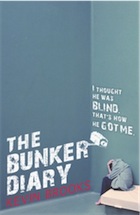
Here are the opening sentences of The Bunker Diary by Kevin Brooks, which controversially won the Carnegie Medal in 2014:

"10.00 a.m."This is what I know. I'm in a low-ceilnged rectangular building made entirely of whitewashed concrete. It's about twelve metres wide and eighteen metres long. A corridor runs down the middle of the building, with a smaller corridor leading off to a lift shaft just over halfway down. There are six little rooms along the main corridor, three on either side."

Much has been written about Brooks' book and whether it is suitable for children, so I'm not going to stray into that territory. You might consider that I have chosen a non-typical example, but many children's books deal with uncomfortable themes and issues.

Both of these openings are physical descriptions which imply a sense of claustrophobia. They perfectly set the scene for what is to follow, which only gets worse.

The two books have several more things in common:

  • there is no happy ending in either of them; 
  • very unpleasant things happen along the way;
  • the main character is not conventionally likeable.

You can see other parallels from these extracts: the language in both is direct, the sentences straightforward. These stylistic points are undoubtedly a requirement for writing for children. But one can equally find instances of quite 'literary' writing in books for children, for example in the earlier novels of, say, Philip Pullman, such as A Ruby in the Smoke.

The Bunker Diary deals with important psychological and philosophical themes, that are uncomfortable to contemplate. So does Matar's book.

One aspect which perhaps distinguishes In The Country of Men (and other novels for adults) from most novels written for children is the retrospective angle: the narrator is now about 25 years old, and the narrative eventually catches up with him. This is less common in writing for children.

Another aspect that might signify a difference is non-linear storytelling, in which the narrative darts around in time. This is, again, less common in writing for children (however I did use this technique in my new novel Stormteller and, whilst I can't think of one at the moment, I'm sure I've read other children's books which do this).

The other observations to make about the difference between them are the setting (Gaddafi's Libya compared to contemporary London) and the degree of sophistication in the form of prior knowledge or experience that is assumed in the writing of Matar's book.

So to answer my original question, all other thngs being equal, the main aspect I am monitoring as I write for children rather than for adults is constantly gauging that level so it is pitched correctly.

I'd be very interested to know what you think about this topic?

David Thorpe is the author of Stormteller and Hybrids.

Senin, 03 November 2014

The inspiration for my new novel - David Thorpe

Stormteller David Thorpe
My first novel in several years is out this week – Like Hybrids it's still YA, it's still set in the future, but it's very different in subject matter. I thought it might be interesting to talk about why I wanted to write it.

I lived in mid-Wales, where Stormteller is set, for nearly 20 years. After separating from my first wife I eventually landed up in Taliesin, partly because I was attracted to a place named after Wales' legendary bard.

I know the landscape almost as well as I know my back garden now, having walked over much of it. I always felt when I moved to this edge of the British Isles from London that here, unlike most places, the skin of the present is thin: you can feel the vibrations from the past still reverberating down the centuries like thunder beneath your feet.

Just inland from Taliesin village is a collapsed dolmen that is given the name 'Taliesin's grave' – though it is much older than that.


Between my house at that time and the sea, lies Borth bog: you may remember the images in the media last winter when flames were leaping across it from burning peat despite the snow: spooky.


And then Borth itself: a long sliver of a town that shouldn't be there, streamed onto a spur of land against the glint of the sea, on a section of coast that is the most vulnerable in the whole of Wales to storm surges. Again, it was in the media last winter when it was attacked by giant waves.


The spur continues to Ynys Las, a nature reserve of sand dunes opposite the Dyfi estuary from Aberdyfi – a colony of English retirees and yachting people largely immune to the influence of the past.

Above it, however, by the Bearded Lake, is allegedly a footprint left by King Arthur when he passed this way, and north of there the mountain Cader Idris, Welsh for Seat of Arthur.

But the real stories that come from this area are older than Arthur's: the birth of Taliesin and Cantr'er Gwaelod, which is the tale of how the land that now lies beneath Cardigan Bay was drowned by the sea.

It's these, and the beautiful, wild and dramatic landscape, that sparked my imagination to write this novel.

Let me tell you the beginning of the first story: a mother had two children – a beautiful girl and a hideous boy with a hunched back. The girl wasn't a problem, she's not even part of the story, probably got married off to a Prince.

But the boy... the mother felt sorry for him. Perhaps the gift of wit and wisdom might make him popular so she could get him off her hands. So she laboured a year and a day to make a magic potion for him, but on the last day she left the servant boy, Gwion, in charge while she popped out. "Just stir: don't taste," she told him.

You can probably guess what happened next. The long and the short of it is that Gwion got to sample the potion and he received all the gifts intended for the son. He was the one who became Taliesin.

Nowadays, Taliesin is revered in Wales and beyond for his poetic and shamanic genius. But his talents should have belonged to someone else – the son, whose name is Afagddu. No one remembers him now, but Taliesin has a village and even an arts centre named after him.

So I thought: how would Afagddu feel? What would he want?

And this is a starting point for Stormteller.

As a rebirthed baby, Gwion floated down the Dyfi river to Ynyslas where he was found by a local prince, who named him Taliesin. That leads into the second story....

...with a tragic ending – the flooding of the land – that it seemed to me has echoes of the threat that Borth and the whole coast of Britain faces now and in the future: rising sea levels, more storms and extreme weather caused by climate change.

We all feel threatened by climate change. We feel powerless to do anything about it. So I wanted the novel partly to be about giving some degree of optimism. It's trying to look at the question of rewriting the endings of stories: ours – about climate change – and these two old legends.

It's easy to give into a sense of fatalism. I believe that we can all rewrite our stories, we at least have the power to do that. And this is true for the teenagers in the novel. But, as in life, there are always sacrifices to be made...

You can find out more about the background to the novel here.

Jumat, 03 Oktober 2014

What are agents looking for? – David Thorpe

I had the pleasure last month of attending the Agents' Party at Foyles bookshop on Charing Cross Road, London, organised by the Society of Children's Book Writers and Illustrators (SCBWI).

It was called a party, but I'd say that's stretching the term; despite the free wine and nibbles, gratefully received, this was a place to pay full attention.

The agents attending were a good cross-section. Those on the panel were:

  • Ella Kahn DKW Literary Agency
  • Jo Williamson Antony Harwood Ltd
  • Julia Churchill A.M. Heath Literary Agents
  • Lauren Pearson Curtis Brown
  • Penny Holroyde Caroline Sheldon Literary Agents
  • Yasmin Standen Standen Literary Agency.

There were also other agents in the room:
  • Alice Williams David Higham Associates
  • Bryony Woods DKW Literary Agency
  • Elizabeth Briggs LAW Literary Agents
  • Eve White and Jack Ramm Eve White Literary Agent
  • Hannah
 Whitty Plum Pudding Illustration
  • Louise Burns Andrew Mann Literary Agency.
In the assembly were up to 80 of us writers and illustrators. On the way in we were handed two badges to fill in and stick onto our clothing: one saying our name, and the other our favourite children's character.

I spotted at least one person who'd chosen a character from their own book. There's confidence for you.

Who did I choose? – Skellig, the brilliant creation from David Almond's beautiful novel, a broken winged human found in a garden shed who, maybe, has miraculous powers. I thought he might bring me good luck.

Thus protected, I entered the airy new seminar room on the top floor of the wonderful new bookshop (they've moved a few doors down the hill away from the Crossrail engineering works. I went to the old bookshop first by mistake – shows how long since I was last there!)

(ASIDE: I remember the days when Foyles was completely disorganised, full of dusty piles of randomly assorted books that the overworked staff never got around to sorting out. If you wanted a book, it could take you days to burrow through them, like looking for a diamond in a snow drift, you'd have to take a whole week off work. While the old bookshop was definitely Dickensian, the new one is well into the 21st-century.)

Yes! There were a few familiar faces, very nice to see some old friends I hadn't seen for ages. (I confess I am a lapsed SCBWI-er, recently returned to the fold.)

So first of all there was a panel with Nick Cook as the ringleader, and lots of questions being asked about what agents are looking for, and how they make their choices, and then we could queue up to talk to them individually.

Here's what I took away from it:

In the younger age group, humour is popular and perhaps something with a strong literary bent. Others are looking for something more quirky, but above all they are looking for a powerful voice, something with attitude, strong and moving. Some of them were looking for a paranormal story, some for something with lots of twists.

Other keywords for older readers included dark, emotional,  historical, with flow, written from the heart, and another interesting thing was said by Ella: "I know it's ready to be submitted to a publisher when I get lost in it".

That is really important in the context of answering the question: "When do I submit? – Either to a publisher or an agent". The answer is, don't send it in until you are absolutely sure it is ready for publication; is it in the form that you would like to see it in print? Because if it is, then the agent or editor receiving it will stop looking for mistakes and become absorbed, as if they were reading a book that had already been published.

And then all the agent has to do is send it straight off to their favourite editor. With absolutely no work for them. What could be better?

In connection with this, another piece of advice was: take your time. There's no rush to submit, not even when an agent gets back to you and suggests some changes. It's far better to get it right than to get right back.

That certainly good advice and probably the best thing I took away from it.

Website: davidthorpe.info. My new book, Stormteller, is out at the end of the month.

Rabu, 03 September 2014

You like to think you're changing the world, but... by David Thorpe

When I was starting out as a writer as a student and concentrating on comics I had a mental crisis that I wasn't going to make enough of a difference to the world just by writing comics. 

But then I had a dream (while camping in the Bois de Boulogne, on the outskirts of Paris) which was very explicit. It said that if one person has their life changed as a result of something I write, then it would have been worthwhile.

Fine. So, eventually, I ended up working for Marvel comics, etc.

Then I started writing YA dystopias.

And I thought that by writing dystopias I was getting people to question the way the world was going and perhaps work for a better world. After all that's how it worked in my case. (I have parallel careers as an environmentalist and a writer.)

Then dystopias became two-a-penny.

And it turns out I was wrong. Firstly there's this article which has just appeared in the Guardian Online, which appears to suggest that modern dystopic YA novel such as the Hunger Games do nothing of the sort. This, despite the obvious satirical intention was partly a critique of mass entertainment.

I don't particularly agree with this critique, which also says that this book and Divergent are right wing attacks on more egalitarian types of government. I think it's more than a little paranoid. I think it's more likely that readers only end up being sucked into the consumer market, instead of questioning it.

But here's something even more damning to the notion that by getting kids to read dystopic fiction we're helping to create a better world.

My friend George Marshall was researching his new book Don't Even Think About It: Why Our Brains Are Wired to Ignore Climate Change and, because he is a comics fan, despite the fact that his book is about psychology, managed to wangle it that his research included going to the biggest comics convention on the East Coast, ComicCon. Well, of course.

In between looking for great graphic novels, he asked fans of dystopias what they thought the future will be like. He said: "My reasoning is this: These people are young, smart, and curious about technology and future worlds. They must have some good ideas."

But no. Marshall writes:
Brian Ferrara is selling nine-hundred-dollar replica weapons from science fiction video games. “I’m not a doomsday prophecy kind of guy, but I am a realist,” he says. So, being realistic, he doesn’t see a bright future, but he is very vague about the details. Maybe, he speculates, we will be immobilized, strapped to a chair with a feeding tube.  
One couple are more politically alert, having spent time with the Occupy movement. They anticipate some kind of corporate dystopia, But, they say, there are other issues too. Overbreeding. The constant battle over fertility rights. “Yes,” says the woman, warming to the theme. “Politicians! Get out of my uterus! Leave my lady parts alone!” In her onepiece latex Catwoman outfit, she looks reasonably safe for the moment. 
And climate change? In over twenty interviews, not one person mentions climate change until I prompt them to do so. Then they have lots of views. No one doubts that it is happening or is going to be a disaster. “It will escalate into catastrophe.” “If we can’t cope with that, we’ll all die like the dinosaurs.” But asked to identify when these impacts might hit, they reckon it’s still a long way off. “Maybe my great-grandchildren will have to deal with it,” Catwoman says.
It doesn't really prompt them to do anything about it. Except buy more comics.

So, I conclude, dystopias have become just another commodity, dealing out escapism. Which is a bit depressing, given that my next novel, Stormteller, out next month, is a dystopia/fantasy about climate change.

Do you think your writing can change anything?

Minggu, 03 Agustus 2014

The shadow knows – it's Adventure Time! – by David Thorpe


Have you watched Adventure Time? Maybe you have seen the comic or the graphic novel or some of the merchandise. It's a phenomenon, not least because of the age range it seems to appeal to. It is a show on the Cartoon Network, which the network claims tops its ratings and is watched by 2 million 2–11 year old boys – but I know many older kids, including students, who watch it avidly too.


When I first saw it I must admit I was surprised that something as violent, surreal and bizarre – and sometimes with such horrific and sexual content – was being aired for young children. It has a PG rating but that does nothing to keep it from young children's impressionable brains.

Here's a list of extreme stuff you can find in it. It includes: "Lots of references to sex, ejaculation, viagra, sex-positions, sexual remarks and humor." And here's a spoof web page parodying the reaction of the Christian right.

Disney it is not.

I think it's brilliant (but then I have a degree in Dada and Surrealism), and its freshness is perhaps partly because it's not written in the conventional sense (by a writer or writer team) but produced by artists using storyboards that are then developed by a team, even going so far as deliberately to employ surrealist techniques such as the Exquisite Corpse game in order to come up with ideas. It's also hand-drawn, each 11 minute episode taking 8–9 months to make.

Now: "Who knows what evil lurks in the hearts of men?" This was the line that introduced the American radio show The Shadow in the 1930s (it later became a film, comic book series, etc etc). One answer is (besides the eponymous detective) – that children do. Children are far more preoccupied with questions about what adults call the dark side of human nature than many adults give them credit for. The best children's writers know this.
the Shadow knows

Adventure Time is therefore in the same ballpark as Where the Wild Things Are...


... and the darkest of nursery rhymes and fairy stories....


 ... the kind that were explored by Angela Carter in her novels about growing up such as the Magic Toyshop and the Company of Wolves...


...stories where grandmothers turning to carnivorous beasts, the bedroom is populated by monsters, and the house next door contains versions of your own parents but with buttons for eyes (thanks, Neil)...


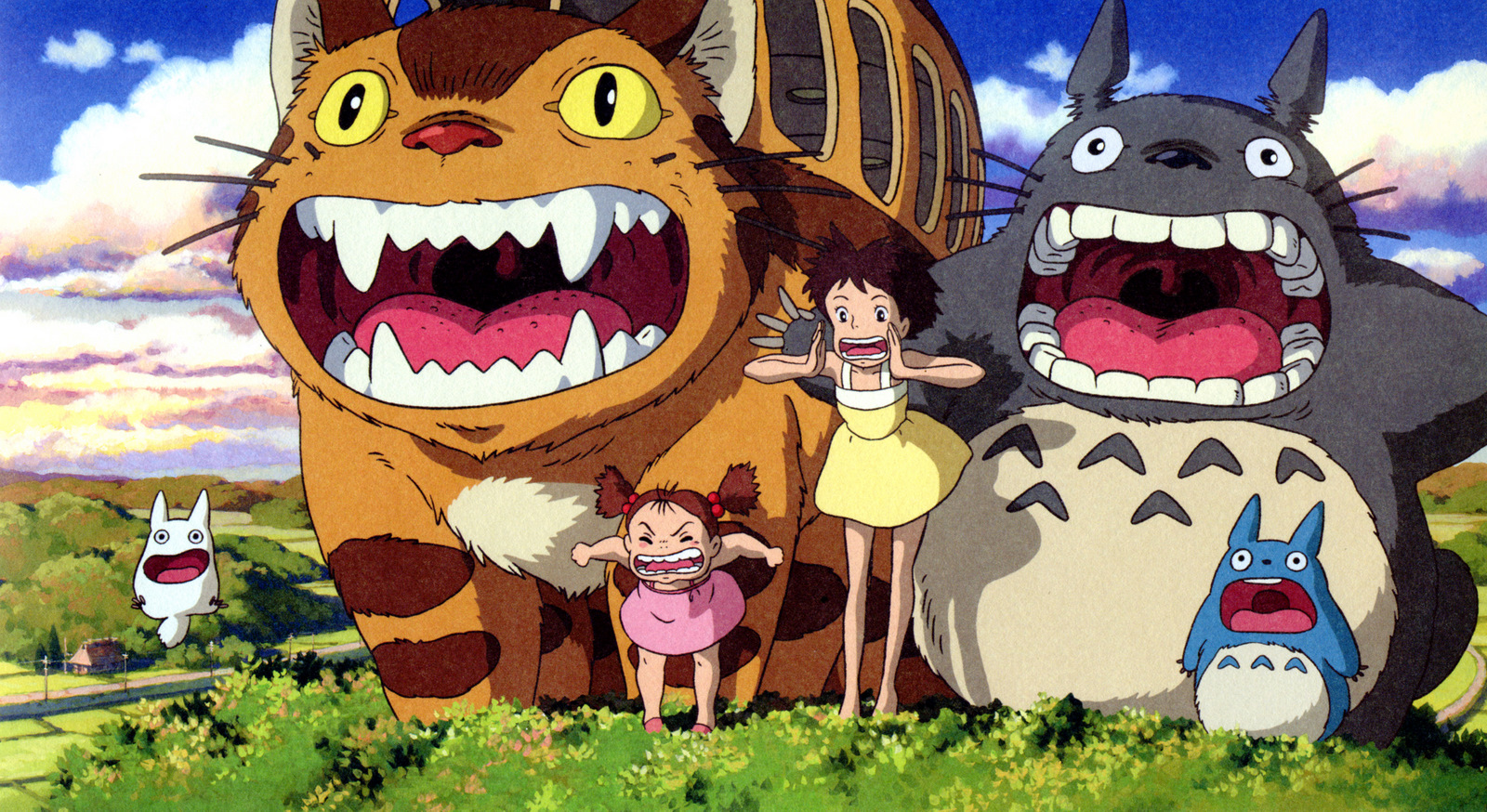
But it's also in the same ballpark as beautiful wonder-filled Hayao Miyazaki films such as My Neighbour Totoro.


There is a genuine sense of beauty, spirituality and awe in many of Adventure Time's episodes or scenes, that is also shared by children who are viewing the world for the first time. It's as if the creators have been able to access their own infantile selves to identify with the way that children see the world.

My reference to The Shadow was chosen for another reason: the parts of the personality satisfied in its fans by Adventure Time and these other stories can be seen as parts of the 'shadow self', as described by the poet Robert Bly in his A Little Book on the Human Shadow.

The Jungian theory of the human shadow, itself part-derived from myths and old stories, is that babies and young children have what Bly calls a 360° personality. But much of this compass of human potential is socialised out of their behaviour during their upbringing. By the time they are around 20 years old just a slice remains. This is the socialised personality that becomes fixed as an adult.

The remaining portion is buried – the shadow – but it emerges in odd ways: our obsessions, the imaginary traits we project onto situations and other people, particularly our partners, the things we are frightened of, particularly in ourselves.

Bly says that after the age of 40 or so – the age of the midlife crisis – adults often start to unpack their shadow. Their reaction to this process determines the rest of the course of their lives.

The shadow is not bad, nor evil. Those are labels that adults put onto things. The shadow contains just what was suppressed, punished or ignored during the socialisation or upbringing process, and depends on the values held by the parents and the culture they belong too.

And this, I think, is why Adventure Time appeals to young adults as well as children. Young adults are struggling with those aspects of themselves which adults want to repress. In young adults there is a sense of nostalgia for their childhood self, that remains as a fading echo before the responsibilities of adulthood unkindly snuff it out altogether and they forget forever what being a child is like. They know this is going to happen, they regret it and they try to cling on to its last vestiges as long as possible.

The shadow is important, vital, necessary, and it is dangerous to repress it or ignore it. The makers of Adventure Time, and the Cartoon Network that commissions it, cannot be unaware of this. It is a liminal gate to the subconscious, the place where creativity thrives.

If I seem to be making rather grand claims for what is after all a children's cartoon I make no apologies. We all, as writers, are gatekeepers to this realm, aren't we? And each of us, in our own unique way, delves beyond the gate to do our work.

Kamis, 03 Juli 2014

The shape of a story must be archetypal - David Thorpe

This is weird. For years I went by the standard Hollywood scriptwriting rule which says that the three act structure is god. As it was taught to me in my scriptwriting class and as I taught it to hundreds of students, in a standard drama act one finishes one quarter of the way in and act three begins one quarter before the end. There's also a midpoint where there's another not quite so pronounced change of direction or momentum.
3-act-structure

I tested it out many times with my watch while watching movies and even when writing scripts, counting the number of pages in, to confirm that at these magical points the main plotline undergoes a major shift of direction or gear. Of course you all know this.

Plenty of stories do not quite conform to this rule (usually short or very long or episodic ones) and post-modern writers mess about with it. If there are many subplots or intertwining storylines there will also be distortion, but you can often pick apart these individual storylines and apply the same rule to them.

It's not as if this is deliberate. It seemed to be an intrinsic quality of the way the human mind appreciates the telling of a story and, correspondingly, the writing of one.

Now the novel I am principally engaged on right now has an unusual storyline: it is circular, so in principle has no beginning, middle or end. It's a story (and I don't want to give too much away) that I had been wrestling with how to tell since I first thought of the idea almost half a lifetime ago.

Many times I came to it, tried to write the opening pages and got nowhere. I put it down but it kept bothering me. I knew there was a really good idea in there somewhere. But because it was circular I couldn't get a handle on it, from a dramatic point of view. There were other issues: I needed to do research and at the time wasn't fully capable of it. Some stories have very long gestation period.

Sometimes when you are struggling with a problem like this you read another novel that is quite different and it can give you a sudden insight into your own story, and for me in this particular case it was reading The Raw Shark Texts by Steven Hall which is a very curious book indeed. In case you haven't read it, it is about creatures which exist beneath the surface of a page when you are reading a book which have a life of their own and if you're not very careful they can devour you.

That's quite a powerful idea. It gave me another idea, also, I like to think, powerful. I put it into my mix.

The second new ingredient came from reading a non-fiction book, The End Of Time by Julian Barbour, which argues that time does not exist – except in our consciousnesses. It's quite possible to describe the universe mathematically without recourse to time, he argues.

But if there is no time, how can a story have beginning, middle or end? In fact, how can there be stories at all? Logically, outside of our consciousnesses, stories are impossible. They do not exist 'out there'. We invent them to entertain each other and help ourselves remember stuff.

The third and final necessary ingredient for me to get a handle on my story was to determine the point of view. Up to then I did not have one, other than that of an omniscient narrator. It all fell into place when I realised that I needed a new character from whose perspective everything else was told. Once this had dawned on me, and I'd decided upon who that character was and his relationship to the other protagonists, the story could be written.

First I wrote the synopsis, then a long treatment. I needed to have it all plotted out because it was very complicated. Two years later I found the time to write the first draft and completed it by summer 2013. I left it for nearly a year and then completed the second draft last month.

I then thought I would try an experiment, and I looked at what happened precisely one quarter, one half, and three quarters of the way through the draft. Lo and behold, there were the plot points – in exactly the places where the theory said they should be.

How did this happen? I have a hypothesis, but that's all. Even though the story is circular I had to start it somewhere. Given that my narrator is deliberately telling the story for the benefit of another character in the novel, then the story begins at the most significant entry point for him. He then recounts the story until he reaches the point at which there is a suitable ending for him. This is just his perspective on the events.

Another character might have begun to describe the events at a different temporal point. Nevertheless I chose the character of the narrator, and therefore I am ultimately responsible for choosing where the novel starts to describe the circle of events, and it made total sense to start it there once I had made that choice.

I am incapable, however, of working out whether the final emergent structure is subconsciously imprinted into the novel because it is so deeply engrained in my own mind – as a kind of self-fulfilling prophecy – or whether it would have been there anyway. I know that I needed to establish the characters and the situation before the story could really take off, and I know that the pacing and dramatic intensity needed to increase as the narrative progresses. So I surmise that I had probably adopted the structure and these principles without deliberate intention.

3-act-structure and dramatic tension

It's vaguely satisfying to know that this happens automatically but also slightly disturbing. I have felt, at times, like dividing the chapters or episodes up and randomly shuffling them to see if anything interesting emerged from the new ordering, but intuitively I suspect that might be a waste of time. An interesting experiment nonetheless. Perhaps I still ought to do it.

I think Barbour is right, and time – therefore stories – do only exist in our minds. Story structure is a necessary consequence of consciousness because we cannot appreciate what comes later without knowing what has come before – whether the story is true, historical, or fiction. We also need to be made to care for the characters before we are motivated to turn the page.

We are prisoners of time and so bound to the logic of narrative. We seek beginnings, middles and ends even where there are none.

I wonder if any of you have similar experiences your own writing processes?

Rabu, 04 Juni 2014

Loughborough University Literary Salon 2014 by Savita Kalhan


I was invited to take part in Loughborough University’s 2nd Literary Salon by Kerry Featherstone, lecturer in English. Industry professionals were invited: Walker Books and the literary agents from DKW, and another author – Maxine Linnell. The subject of the Salon was: Writing YA Fiction. We were each invited to speak, followed by a Q and A session, and, at the end of the evening, there was a Round Table. The audience comprised students, lecturers, authors and anyone in the local area interested in Teen/YA fiction. There was a great turn out and an interested and involved audience, with lots of discussions.

My talk focussed on the realities, good and bad, of being a children’s writer in the modern world, what an average advance might be, royalties, the changes in the publishing industry, and my experiences of being a teen/YA writer. I tried to give a balanced view on how difficult it is to make a living from writing, how a children’s writer today has to wear very many hats, know the industry and know how it works, while not neglecting the most important aspect of being an author: writing a book. I was a little surprised by how many students of creative writing were unaware of the realities of being a children’s writer.

I hope I didn’t put them off wanting to be writers!
 
The round table discussions focussed on various issues, including age banding in children’s books, the changing reading habits of children and teenagers, and diversity in children’s books. Bali Rai joined the round table and talked about how he and Malorie Blackman have been discussing the lack of diversity in children’s literature for many years, and how little has changed in that time. I’ve blogged about diversity in Teen/YA lit here on An Awfully Big Blog Adventure here and on The Edge Blog here, and for Teen Librarian Monthly here. Reading David Thorpe’s interesting post on yesterday’s blog, made me wonder about the diversity in the ethnicity of the children who had entered the 500 word story writing competition where 118,632 entries were received.

The Literary Salon was a very good event for students who were interested in pursuing a career in writing. They got to meet a publisher, agents and writers, and to put questions to them. It was the kind of event I would have loved to have gone to when I first started writing and knew so little about the publishing world.

Book Trailer for The Long Weekend


Savita Kalhan's website here

Savita on Twitter here

Selasa, 03 Juni 2014

Let's hear it for the kids: more literate and creative than ever - David Thorpe

Who says today's children are being dumbed down? Who says the intelligence, literacy and creative ability is weakening compared to previous generations? (Could it be Michael Gove?)

I personally detest it when people put down children in this way. Any writer or teacher who goes out to meet kids in schools knows how smart they are. I believe that modern technology has made them far smarter than us oldies were at their age. They have a wider vocabulary and a much greater appreciation of the world, brought about by the broadened horizons made available by the Internet, games, books and a smörgåsbord of television channels. They probably also travel much more widely than we did 50 or more years ago.

All of this has had a marvellous effect. This is underlined by the results of BBC Radio 2's and the Oxford University Press' 500 words competition for children announced a few days ago, in which children had to compose an original work of fiction of 500 words.

They received a record-breaking, staggering 118,632 entries. Wow. Oxford University Press dictionary's team has analysed the stories to find out what words kids are using the most and the extent of their vocabulary, etc., all stuff that is of interest to us writers.

The most interesting thing first of all is the gender split. Girls outnumbered boys entering the competition by about 2 to 1. Three quarters of the entrants were in the 10 to 13 age range, the rest being nine and under. That probably means that girls in that age range are more likely to read books than any other children.

Now: how reassuring that the most common noun used in the stories is: 'mum'; and the most common adjective: 'good'.

Despite the fact that girls wrote twice as many of the stories, the main protagonist is more likely to be a boy. Now why do you think that is?

And the commonest name, used 27,321 times, is Jack, closely followed by Tom, Bob and James, all solid Anglo-Saxon names. I was certainly surprised to find that the most common girl's name is Lily/Lilly (17,981), closely followed by Lucy, then Emily and Sophie, also traditional English names.

And the most common historical figure? Adolf Hitler (used in 641 stories) followed by Queen Victoria (258).

I'd like to see Nigel Farage and his ilk use this as evidence for the insidious infiltration of multiculturalism into British culture. Actually it goes to show the opposite: there is no cause for concern, if anyone is concerned, that British culture is being watered down (although the research results are not accompanied by an ethnicity breakdown of the entrants to enable us to determine whether Celtic or Anglo-Saxon-originating Brits are unevenly represented amongst the entrants).

Looking at the keywords used in the stories, children were especially interested by this year's floods, with that single noun being by far the most commonly used (4008 uses), followed largely by non-real-world originating terms, coming from films and computer games: Lego, minion (used in Despicable Me), Minecraft and flappy (from the game Flappy Bird). Other words commonly used derived either from games or recent events such as the Winter Olympics.

What about new words? The research found that popular culture and social media have given rise to new verbs such as 'friended', 'Facebooked' and 'face-planted'. These will no doubt be finding their way into the next edition of OUP's children's dictionary.

Now for the really good news: children know - and are not afraid to use - really long words, including some that you or I may not even know: how about 'contumelious'? As used in the following context:
The girl springs to her feet losing all caution and apoplectic with outrage. "How dare you?" she cries, "Fighting them is bad enough, but capturing one to be slaughtered, as if it were a common boar, is contumelious. They will take their revenge and it will be terrible." (The War Party, girl, 13)
Or hands up who knows what 'furfuraceous' means? As used in:
Folkrinne's crown was placed on his furfuraceous head. The Basilisks applauded and cheered for the corrination of their new king of Malroiterre. (The Basilisk king, girl, 12)
(OK, so there was a spelling mistake in that, but I forgive this author because I think furfuraceous is a lovely word, conjuring up such a beautiful image in my mind).

And what about making up words? Children are not afraid to do this because, as you and I know, it is so much fun. My favourite made-up word quoted from the stories is 'historytestaphobia' because I absolutely used to suffer from that when I was at school. I also love 'Mucaologist', which is apparently a collector of mucus.

Finally, telling stories is not just about the words you know but the order in which you put them, and these children seriously know how to build suspense using perfectly ordinary words. As the report writers say:
If asked to write on a theme of mystery and suspense, one would not immediately think of the words door, house, step, and walk and yet the following example shows clearly how these words can be used to build suspense:
'Something had caught his eye. He turned around and saw an old, creaky house standing on its own in the middle of the woods. He took one step towards the scary house. He got closer and closer until he reached the house. Ben slowly walked up the cracked steps to reach the front door. Ben was scared out of his skin. Although on the outside he was brave. He pushed the rotten door and took a step inside the house.' (Haunted House, boy, 11)
All of this makes me happy, because it shows that there will continue to be a hungry audience for anything we writers produce, and, moreover, in a few years' time there will be more fantastically creative young adults ready to take our place.

Let's hear it for the kids.